Endoscopic & Minimally Invasive Spine Surgery Hyderabad

Written by
Published 10 September 2025Updated 19 October 2025

Advanced endoscopic spine surgery in Hyderabad. Experience Day Care procedures, Keyhole Incisions, and Awake Spine Surgery options, when examination and imaging support them.

Yashoda Hospital, Malakpet • Room No. 317, OPD Block

Visit Our Neurosurgery Clinics in Hyderabad

Expert neurosurgical care available at multiple convenient locations across Hyderabad.

For high-risk or elderly patients

If you need to avoid general anaesthesia because of cardiac, lung, or metabolic risks, we offer an awake endoscopic spine pathway using spinal/epidural blocks with light sedation.

What is Minimally Invasive Spine Surgery?

Minimally invasive spine surgery (MISS) uses advanced endoscopic techniques to treat spine conditions through smaller incisions, with less disruption of the back muscles than open surgery.

Dr. Sayuj Krishnan specializes in endoscopic spine procedures, using small incisions and muscle-sparing access. Recovery is individual. Learn more about our local patient journey for endoscopic spine surgery in Hyderabad.

How Endoscopic Spine Surgery Works

1. The Tiny Incision

A small keyhole incision (< 1cm) is made under local anesthesia, often covered with just a band-aid.

2. Muscle Preservation

Instead of cutting muscle, we use a series of dilators to gently separate fibers, creating a natural corridor to the spine.

3. HD Visualization

A high-definition endoscope provides a magnified, crystal-clear view of the nerve root and disc herniation.

4. Targeted Decompression

Specialized micro-instruments remove only the damaged disc fragment, instantly relieving pressure on the nerve.

Compare: Endoscopic vs. Traditional Surgery

How the endoscopic and open approaches differ for conditions like sciatica and slipped discs.

Comparison of Endoscopic vs. Traditional Surgery
FeatureEndoscopic (Keyhole) SurgeryTraditional Open Surgery
Incision SizeTiny (< 1 cm)Large (3-5 inches)
Muscle DamageMinimal (muscles dilated, not cut)Significant (muscles stripped)
Blood LossNegligibleModerate
Hospital StayDay Care / 24 hours3-5 days
Post-op PainMild (oral meds only)Moderate to Severe
Recovery TimeReturn to work in 1-2 weeks4-6 weeks or more
ScarringAlmost invisibleNoticeable scar

Your Treatment Journey

1

Initial Assessment

MRI review and clinical exam. Secure tele-consult available for outstation patients.

2

Pre-Op Planning

Fitness check and anaesthesia clearance. Option for Awake Spine Surgery protocol.

3

The Procedure

45-90 mins endoscopic surgery through a keyhole (8mm) incision.

4

Immediate Recovery

Mobilisation starts when anaesthesia and pain control allow. Timing is individual.

5

Discharge

Discharge timing is individual and decided after examination.

6

Rehabilitation

Activity progression is planned at follow-up.

Watch: Endoscopic Discectomy for L5-S1 Herniation

Video Transcript: L5-S1 Endoscopic Discectomy

[00:00] L5-S1 paracentral disc herniation is a common condition where the nucleus pulposus pushes out, compressing nerve roots and causing lower back pain, sciatica, and weakness.

[00:30] When conservative treatments like physical therapy and injections fail, L5-S1 endoscopic discectomy offers a minimally invasive option. This procedure is performed through a small incision.

[01:00] The endoscopic approach removes the disc fragment under direct vision while preserving spinal stability.

[01:20] Key Benefits:

  • Tiny incision (less than 1 cm)
  • Minimal muscle damage
  • Hospital stay and recovery are planned for each patient after examination

[01:45] If you are suffering from persistent sciatica or back pain, consult Dr. Sayuj Krishnan to see if you are a candidate for endoscopic spine surgery.

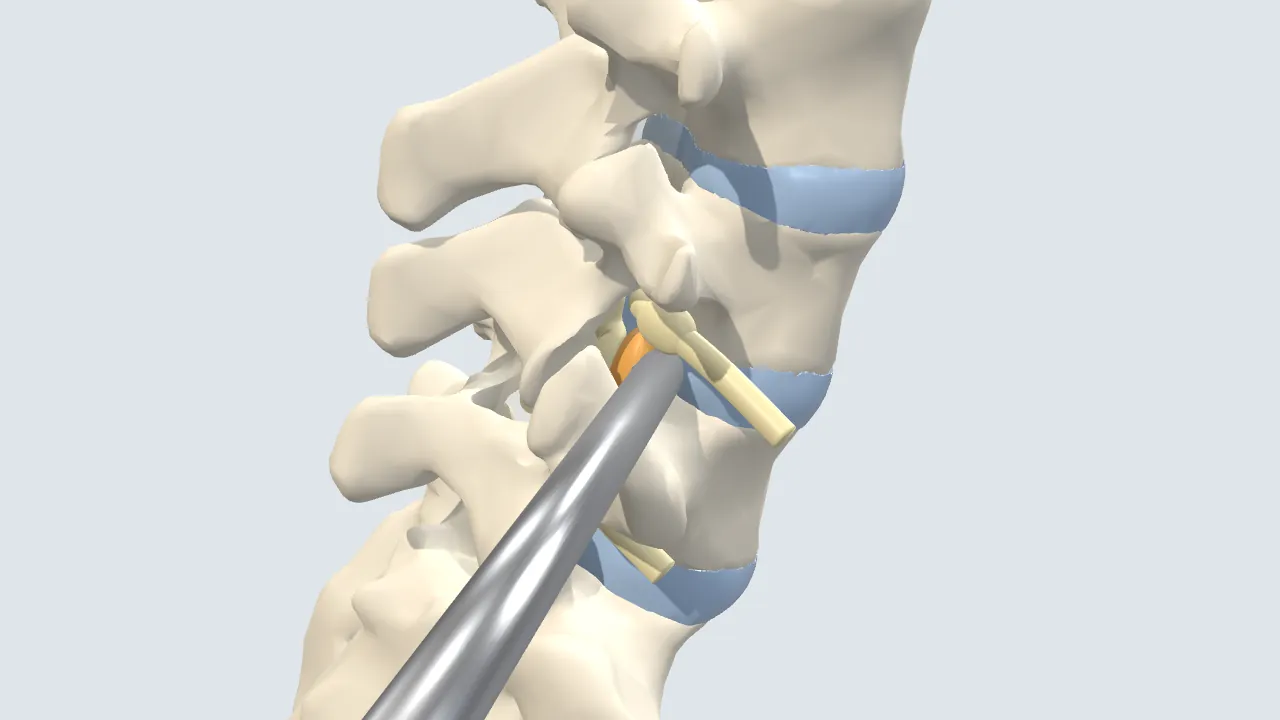
One Example in 3D: Endoscopic Discectomy at L4–L5

Minimally invasive spine procedures differ in their route and instruments. This model shows one of them: a transforaminal endoscopic discectomy, where the working tube and endoscope pass through the opening beside the L4–L5 joint to reach a disc fragment next to the nerve root, at the moment the fragment is grasped.

Illustration of the lower spine seen from the side and slightly behind, with a thin tube and endoscope passing through the opening beside the L4–L5 joint to reach a disc fragment next to the nerve root.
Illustration for education; individual anatomy and surgical plans vary.Anatomical data: BodyParts3D, (c) The Database Center for Life Science licensed under CC Attribution-Share Alike 2.1 JapanThis 3D model and its preview image are adapted from BodyParts3D and are licensed under CC BY-SA 2.1 JP. Licence terms

Diagnosis & Eligibility

Accurate diagnosis is the first step towards successful treatment. At Yashoda Hospital, we use advanced imaging and clinical evaluation to determine if you are a candidate for endoscopic surgery.

Diagnostic Tests We Use

  • •MRI Spine: Essential to visualize disc herniation and nerve compression.
  • •Dynamic X-Rays: To check for spinal instability (slippage) during movement.
  • •CT Scan: Detailed bone imaging for fractures or bony spurs.
  • •Nerve Conduction Studies (NCS): To confirm nerve damage if diagnosis is unclear.

Who is a Candidate?

  • ✓Patients with radiating leg pain (sciatica) or arm pain.
  • ✓Those who have failed 6 weeks of physiotherapy and medication.
  • ✓Difficulty walking due to spinal stenosis (claudication).
  • ✓Presence of progressive numbness or muscle weakness.

Post-Operative Care Guide

Diet & Hydration

  • • Drink plenty of water (3-4 liters)
  • • High protein diet for healing
  • • High fiber to prevent constipation

Wound Care

  • • Keep incision dry for 3 days
  • • Change dressing if soaked
  • • No swimming/tub bath for 2 weeks

Do's & Don'ts

  • • Do: Short walks every hour
  • • Don't: Lift >5kg for 3 weeks
  • • Don't: Twist or bend excessively

Procedures We Offer

Transforaminal Endoscopic Spine Surgery (TESS)

Ideally suited for paracentral and foraminal disc herniations. Accessed from the side (flank) under local anaesthesia, avoiding the spinal canal entirely.

Benefits:

  • • Local anaesthesia option
  • • Side access for selected herniations
  • • Small working channel
  • • Suture-less closure in selected cases
Typical Recovery: Discussed after examination

Interlaminar Endoscopic Spine Surgery (IESS)

Used for selected L5-S1 disc herniations and spinal stenosis. Accessed from the back through the natural interlaminar window.

Benefits:

  • • Posterior approach
  • • Stenosis and disc can be reviewed
  • • Limited muscle dilation
  • • Suitability decided after MRI review
Typical Recovery: Discussed after examination

Endoscopic Foraminotomy

Decompression of nerve roots through enlarged foraminal openings using endoscopic techniques.

Benefits:

  • • Nerve decompression
  • • Minimal tissue disruption
  • • Small incision
  • • Suitability decided after MRI review
Typical Recovery: Discussed after examination

Endoscopic ULBD

Unilateral laminotomy bilateral decompression for spinal stenosis using endoscopic approach.

Benefits:

  • • Bilateral decompression
  • • Preserved stability
  • • One-sided access
  • • Stay decided by the team
Typical Recovery: Discussed after examination

Cervical Procedures

Endoscopic cervical discectomy and foraminotomy for neck and arm pain relief.

Benefits:

  • • Anterior approach
  • • Preserved motion
  • • Small scar
  • • Mobilisation timed by the team
Typical Recovery: Discussed after examination

MIS TLIF (Fusion)

Minimally Invasive Transforaminal Lumbar Interbody Fusion for instability or spondylolisthesis.

Benefits:

  • • Small incisions
  • • Muscle-sparing screw placement
  • • Interbody cage and graft
  • • Stay decided by the team
Typical Recovery: Discussed after examination

Credentials and clinic notes

Credentials

MBBS and DNB Neurosurgery. German observership in full endoscopic spine surgery (2024).

Advanced Safety

Neuronavigation and neuromonitoring are used when the operation requires them.

Recovery Planning

Selected patients may mobilise the same day; discharge timing is individual and decided after examination.

Ethical Care

Transparent pricing and honest surgical indications.

Is Endoscopic Spine Surgery Safe for Elderly Patients?

Anaesthesia, blood loss, and medical fitness are reviewed individually, including for patients over 60. Whether an endoscopic approach is suitable depends on the MRI and the examination.

  • ✓Local Anesthesia/Sedation: Avoids the cardiac stress of general anesthesia.
  • ✓Minimal Blood Loss: Crucial for patients on blood thinners (managed carefully).
  • ✓Early Mobilization: Reduces risk of pneumonia and DVT (clots).

Second Opinion for Senior Citizens

If a major open operation has been advised, bring the MRI to OPD. Whether an endoscopic approach is suitable is decided after examination.

Book Senior Citizen Consult

Estimated Cost of Treatment

Transparent pricing for self-pay patients. Insurance packages available.

ProcedureEstimated Cost Range (INR)Typical RecoveryIncludes
Endoscopic Discectomy (Lumbar)₹95,000 - ₹1,35,000Discussed at OPD
  • Surgeon fees
  • OT charges
  • Implants
  • Follow-up visits
Endoscopic ULBD (Stenosis)₹1,20,000 - ₹1,60,000Discussed at OPD
  • Bilateral decompression
  • Hospital charges as billed
  • Medications
Cervical Endoscopic Discectomy₹1,20,000 - ₹1,70,000Discussed at OPD
  • Anterior/Posterior approach
  • Neck brace
  • Physiotherapy guidance
MIS TLIF (Spinal Fusion)₹2,50,000 - ₹3,50,000Discussed at OPD
  • Implants (Screws/Cage)
  • Minimally Invasive access
  • Hospital charges as billed
Vertebroplasty (Cement)₹1,10,000 - ₹1,50,000Discussed at OPD
  • Bone cement
  • Fluoroscopy charges
  • Facility charges as billed

Note: These are estimated ranges for standard cases. Final cost may vary based on room category, specific implants required, and medical complexity. Cashless insurance facilities are available with major TPAs.

What to discuss before Minimally Invasive Spine Surgery

Credentials discussed in clinic: MBBS and DNB Neurosurgery. Germany-related training is a German observership in full endoscopic spine surgery (2024).

Clinical assessment

Examination and imaging

Suitability for this procedure is decided after history, neurological examination, and review of your MRI or CT — not from a published percentage.

Counselling

Risks and alternatives

If a procedure is considered, the visit covers expected recovery, alternatives including non-surgical care, and questions to ask before consent.

Next step

Book an OPD visit

Request a consultation to discuss your scans. Discharge timing and recovery are individual and are discussed after examination.

What to discuss at OPD

Bring MRI films so symptoms can be matched to imaging. Sciatica and other spine symptoms are reviewed at consultation.

Book an OPD visit

When is MISS Recommended?

Suitable Conditions

  • • Herniated discs (lumbar/cervical)
  • • Spinal stenosis
  • • Foraminal stenosis
  • • Nerve root compression
  • • Failed conservative treatment

Patient Selection

  • • MRI-confirmed pathology
  • • Symptoms match imaging findings
  • • Failed 6+ weeks conservative care
  • • No significant instability
  • • Realistic expectations
Tell us about your concern

Provide a few details. The clinic team will review your request and contact you to confirm the appointment.

Score: 5

By submitting, you consent to being contacted on the number provided.

Frequently Asked Questions

What is Minimally Invasive Spine Surgery?

Minimally invasive spine surgery (MISS) uses smaller incisions and endoscopic or microscopic instruments to reach the spine while gently moving muscles instead of cutting them. This approach reduces tissue trauma, pain, and blood loss compared to traditional open surgery.

Laser vs Endoscopic Spine Surgery: Which is better?

Laser spine surgery uses heat to shrink disc material and is often a poor fit for large herniations or bone spurs. Endoscopic spine surgery uses a camera and instruments to remove the compression when examination and MRI support that approach.

What conditions can be treated with Minimally Invasive Spine Surgery?

MISS is recommended when conservative treatments no longer control symptoms from conditions such as herniated discs, spinal stenosis, foraminal stenosis, spinal deformities like scoliosis, and spondylolisthesis. The specific technique is chosen based on the level and nature of the pathology.

What are the core patient benefits of choosing Minimally Invasive Spine Surgery?

MISS uses smaller incisions and aims to preserve the muscles and supporting tissues, which usually leaves a smaller scar. Pain, hospital stay and return to activity are individual and are discussed after examination.

How long does endoscopic spine surgery take?

Most endoscopic spine procedures take 1-3 hours depending on the complexity. Endoscopic discectomy typically takes 60-90 minutes, while more complex procedures like endoscopic ULBD may take 2-3 hours.

What is the success rate of minimally invasive spine surgery?

Outcomes depend on proper patient selection, accurate diagnosis, and the procedure chosen. Suitability and expected recovery are discussed at consultation.

When can I return to work after endoscopic spine surgery?

Return-to-work timing depends on the procedure, your health, and the physical demands of the job. It is decided after examination and follow-up.

Is endoscopic spine surgery covered by insurance?

Yes, endoscopic spine surgery is typically covered by most insurance plans when medically necessary. We provide detailed medical estimates and work with insurance companies for pre-authorization. Cashless insurance approvals are available at Yashoda Hospital.

What are the risks of minimally invasive spine surgery?

Potential risks include nerve injury, bleeding, infection, and incomplete symptom relief. How those risks compare with open surgery is discussed for the specific operation.

Recovery and Return to Activity

1

After surgery

Wound care and pain control are reviewed before activity increases

2

Follow-up

Return to desk work is decided at review, not promised in advance

3

Later activity

Physiotherapy is added only if the clinical review supports it

Patient Concerns & Recovery Realities

Is endoscopic surgery always the right choice instead of fusion?

No. The approach is chosen to match the anatomy. If significant instability exists, a minimally invasive TLIF (fusion) may be required instead of decompression alone.

How long is the actual hospital stay in Hyderabad?

Hospital stay at Yashoda Hospital, Malakpet is decided after the operation.

When can I walk after endoscopic discectomy?

Mobilisation starts when anaesthesia and pain control allow. Timing is individual and decided after examination.

Red Flag Symptoms (When to see a doctor urgently)

Seek immediate medical attention if you experience:

  • •Cauda Equina Syndrome signs: Loss of bladder or bowel control, or numbness in the groin/saddle area.
  • •Progressive weakness: Sudden inability to lift your foot (foot drop) or leg weakness that gets worse.
  • •History of cancer: If you have a history of cancer and develop new, severe back pain.

*These symptoms may indicate serious nerve compression requiring urgent evaluation to prevent permanent damage.

Related Conditions & Symptoms

Spine Conditions We Treat

Related Symptoms

Related reading

Procedure explainers are educational. Book an OPD visit at /appointments to review your scans.

Ready to Discuss Your Treatment Options?

Dr. Sayuj Krishnan (MBBS and DNB Neurosurgery) reviews symptoms, examination, and imaging before any procedure is considered.

Clinical References

External links are provided for transparency and do not represent sponsorships. Each source was accessed on 19 Oct 2025.

Medically reviewed by Consultant Neurosurgeon, Yashoda Hospital MalakpetLast reviewed 19 October 2025

This information is for educational purposes only and should not replace professional medical advice. Please consult with Dr. Sayuj for personalized medical guidance.

Dr. Sayuj Krishnan – Neurosurgeon
Hospital:Room 317, 3rd Floor, OPD Block, Yashoda Hospital, Nalgonda X Roads, Malakpet, Hyderabad 500036